The historic record of the birth of Christ can be found in Matthew 1:18-25 and Luke 2:1-20.Unlike any other baby, the one born that night in Bethlehem was unique in all of history. He was not created by a human father and mother. He had a heavenly pre-existence (John 1:1-3, 14). He is God, the Son—Creator of the universe (Philippians 2:5-11). This is why Christmas is called the incarnation, a word which means “in the flesh.” In the birth of Jesus, the eternal, all-powerful and all-knowing Creator came to earth in the flesh.
The film is set in the East Berlin of 1989 . Alexander Kerner's mother, Christiane Kerner, an ardent supporter of the Socialist Unity Party of Germany, suffers a heart attack when she sees Alex being arrested in an anti-government demonstration and falls into a coma shortly before the fall of the Berlin Wall. After eight months she awakes, but is severely weakened both physically and mentally, and doctors say that any shock may cause another, possibly fatal, attack. Alex realises that her discovery of recent events would be too much for her to bear, and so sets out to maintain the illusion that things are as normal in the German Democratic Republic. To this end, he and his family revert the flat to its previous drab decor, dress in their old clothes, and feed the bed-ridden Christiane new, Western produce from old labeled jars. For a time the deception works, but gradually becomes increasingly complicated and elaborate. Despite everything, Christiane occasionally witnesses strange occurrences, such as a gigantic Coca-Cola advertisement banner unfurling on a building outside the apartment. Alexander and a friend with film-making ambitions edit old tapes of news broadcasts and create their own fake special reports to explain them away. In one scene, Christiane wanders outside the flat while Alex is asleep, and sees all her neighbours' old furniture piled up in the street for garbage collection, a car dealer selling BMWs instead of Trabants and advertisements for such Western corporations as IKEA. Then, a huge military helicopter flies past carrying the upper half of an enormous statue of Lenin, which at an angle appears to be offering Christiane his hand. Alex and his sister find her and take her back to the flat. Alex and his friend create a fake special report stating that East Germany is accepting refugees from the West. A subplot involves the earlier defection to the West of Alexander's father when Alexander was a child, an event which apparently drove his mother temporarily insane, and which prompted her ardent support of the party. Later it is revealed that the defection was planned by them both, but she bailed out to protect her children. Alexander's sister Ariane, now working in a Burger King drive-through, one day sees her father with a new family. Christiane later admits the deception and Alexander goes to find his father, partly for himself and his sister, and partly to honour Christiane's dying wish that she see him one last time. On the way, Alex meets a taxi driver who looks just like his childhood hero, Sigmund Jähn, the first German in space. Christiane relapses, and is once again taken to the hospital. Under pressure to reveal the truth about the fall of the East, Alexander creates one final fake film segment. Alexander convinces the taxi driver to identify himself as Sigmund Jähn, who in the segment becomes the new leader of East Germany, and gives a speech promising to make a better future by opening the borders to the West. Christiane is very impressed by the "broadcast," but in fact already knows the truth, as Alexander's girlfriend revealed everything when Alexander was not around. The tables are turned completely, and it is Alex who is being protected from reality. Christiane dies soon afterwards, and Alex never knows that she did, in the end, know the truth.
In 1938 the Redlich family flees to Kenya from Nazi Germany to escape the increasing persecution of the Jews. Walter, a former lawyer, finds work as a farm manager and sends for his family. His wife Jettel has trouble adjusting to life in Africa, although their daughter Regina quickly adapts to her new environment, easily learning the language of the country and showing interest in local culture. Regina soon forms a close friendship with the farm's cook, Owuor. When war breaks out, the British round up all German citizens, and hold them, whether Jew or gentile, separating men from women. The Redlichs' marriage begins to deteriorate. Jettel sleeps with a German-speaking British soldier to secure work and a home on a farm for the family, and Regina and Walter both find out. Walter decides to join the British army and wants Jettel to go to Nairobi with him, but she refuses and stays to run the farm with Owuor. By the end of the war, Jettel does not want to leave Africa, even though Walter is offered a position as a judge in post-war Germany.
In 1938 the Redlich family flees to Kenya from Nazi Germany to escape the increasing persecution of the Jews. Walter, a former lawyer, finds work as a farm manager and sends for his family. His wife Jettel has trouble adjusting to life in Africa, although their daughter Regina quickly adapts to her new environment, easily learning the language of the country and showing interest in local culture. Regina soon forms a close friendship with the farm's cook, Owuor. When war breaks out, the British round up all German citizens, and hold them, whether Jew or gentile, separating men from women. The Redlichs' marriage begins to deteriorate. Jettel sleeps with a German-speaking British soldier to secure work and a home on a farm for the family, and Regina and Walter both find out. Walter decides to join the British army and wants Jettel to go to Nairobi with him, but she refuses and stays to run the farm with Owuor. By the end of the war, Jettel does not want to leave Africa, even though Walter is offered a position as a judge in post-war Germany.
Richard, a coal miner from Essen, returns after nearly a decade of being a Soviet prisoner of war in Siberia. In the meantime, his wife, two sons and one daughter have reached a minimum standard of living without him. When he is unexpectedly repatriated in 1954, he has severe problems in reintegrating himself with his family and country. His wife is running a small business, his elder son has become a Communist challenging his father's ideals of the Nazi time, his daughter flirts with his former enemies, American GIs, and his 11-year-old son Matthias, who never knew his father, admires a local football hero instead, Helmut Rahn of Rot-Weiß Essen. While Richard is initially very stern about Matthias' love for football, he gradually softens such that, on the night before the final, father and son drive to Bern to see the match. An additional plot of the movie is the personal triumph of Helmut Rahn, for whom Matthias becomes a lucky mascot. Rahn, nicknamed "The Boss", has a successful record at club level, though is rarely chosen to play at national level in trainer Sepp Herberger's team. There are several miraculous events in the movie. For Richard, it is the sudden joy of scoring a goal with an abandoned football. For Rahn, it is seeing Matthias on the sideline that spurs him into scoring the winning goal. For Sepp Herberger, however, the miracles are more mundane: the sudden rain that slows down the Hungarians, but not so much the Germans fitted with Adi Dassler's revolutionary screw-in football spikes. For all Germans, its the unexpected euphoria of a win that heals many wounds, becoming a symbol of the ongoing economic "miracle".
Cahit Tomruk (played by Birol Ünel) is a German of Turkish descent in his 40s. He has given up on life after the death of his wife. Furthermore, the anguish in his soul continues to cry out for cocaine and alcohol to numb his pain. One night, he intentionally crashes into a wall (hence the title), and barely survives. At the psychiatric clinic he is taken to, Sibel Güner (Sibel Kekilli), another German Turk who has tried to commit suicide, approaches him. She asks Cahit to carry out a formal marriage with her out of the blue so that she can break out of the strict rules of her conservative family. Cahit is turned off by the idea at first, but then he agrees to take part in this plan. As Sibel tells him frankly that she prefers an independent sex life, they live as roommates with separate private lives for a while. They eventually fall in love, and things take a different turn as Cahit kills one of her lovers out of anger and thus he has to go to prison. While he is in prison, she goes to Istanbul, to which he follows her upon his release. Upon arrival, he finds that she has re-married and now has a daughter. Sibel's cousin Selma does not tell Cahit how to find her, so he waits in a hotel for Sibel's call. It eventually comes. He asks her to run away with him, and she agrees to, but never shows.
In student lodgings in Munich, Sopie Scholl and a close friend, Gisela Schertling, are bent over a radio. They sing along softly as Billie Holiday sings "Sugar". Sophie announces that she must go. She walks through darkened streets and quietly steps in a door. In a cellar studio, members of the White Rose student organization, including Sophie's brother Hans, are preparing copies of their sixth leaflet. They have mimeographed more than they can distribute through the mail. Hans hits on the idea of distributing the extras at university the next day. Willi argues that the risks are unacceptable. Hans announces that he will take full responsibility. Trying to reassure the others, Sophie volunteers to assist Hans, explaining that a female is less likely to attract the attention of any security personnel. The next day, Sophie carries a small suitcase as she and Hans walk to the main building of Munich University. They cross the square that now bears their name (Geschwister-Scholl-Platz, "Scholl Siblings Square"). In the building, where classes are in session, they set about putting down stacks of leaflets near the doors of lecture rooms. With only minutes left until the period ends, they start to leave, but Sophie tells Hans she still has some copies left over. Running to the top (third) floor, she sets a stack of leaflets on the balustrade, then impulsively pushes them over the edge. The mass of sheets flutters to the floor of the great atrium. Descending the stairs, Hans and Sophie seem safely enveloped in the anonymous throng of students emerging from lecture rooms. However a janitor who saw Sophie scatter the leaflets shouts at them to stop, detains them until police come (quickly) and arrest them. The Gestapo orders that the building shall be sealed. The siblings are taken to the Munich Stadelheim Prison, where Sophie is interrogated by Gestapo investigator Robert Mohr. Claiming initially to be apolitical, she presents an elaborate alibi; she and her brother had nothing to do with the fliers, she merely noticed them in the hall and pushed a stack off the railing because it is in her nature to play pranks; she had an empty suitcase because she was going to visit her parents in Ulm and planned to bring back some clothes. Her deception seems to be working; she is dismissed. As her release form is about to be approved, though, the order comes not to let her go. She is placed in a prison cell with fellow prisoner Else Gebel. The investigation has found incontrovertible evidence that Sophie and Hans were indeed responsible for the distribution of anti-Nazi leaflets. Sophie concedes her involvement (as has Hans) but, determined to protect the others, steadfastly maintains that the production and distribution of (thousands of) copies of leaflets in cities throughout the region were entirely the work of Hans and herself. Mohr admonishes her to support the laws that preserve order in a society that has funded her education (and the educations of her friends); Scholl counters that before 1933 the laws preserved the right of free speech. She has seen police spit in the face of her Jewish schoolteacher, seen mentally disabled children taken away in trucks to be euthanized, learned about the Jewish extermination camps from soldiers returned from the eastern front. Some lives are unworthy, Mohr suggests; every life is precious, counters Sophie, final judgments are not for humans to make. Mohr cannot understand how conscience can be a reliable basis for action. "Without law, there is no order. What can we rely on if not the law?" Mohr asks. Sophie mildly replies, "Your conscience. Laws change. Conscience doesn't." He is affronted by her frank dismissal of Hitler. When she says that she is willing to accept all blame, and refuses to name accomplices, he ends the interrogation.
Actress Julia Jentsch as Sophie Scholl on trial in Sophie Scholl – The Final Days Sophie, her brother, and a married friend with three young children, Christoph Probst, are charged with treason, troop demoralization and abetting the enemy. In the subsequent show trial, Probst is the first to be examined by President of the People's Court Roland Freisler, whose prosecutorial zeal makes the nominal prosecutor superfluous. Freisler contemptuously dismisses Probst's appeals to spare his life so that his children can have a father. Hans maintains a taut composure in the face of Freisler's increasingly impatient questioning. Declining to answer only what he is asked, he avers that the defeat of the Nazi state has been made inevitable by the alliance of Russia, Britain and the United States; all Hitler can do is prolong the war. He has seen the conditions on the eastern front; the judge has not. In her own examination, Sophie declares that, what she and her group have said and written, many people think, but they dare not express such thoughts. Freisler pronounces the three defendants guilty and calls on each to make a brief final statement. Sophie tells the court that “where we stand today, you [Freisler and other Nazis] will stand soon.” Sophie, who had been told that legal practice was that execution was not earlier than 99 days after conviction, learns that she is to be executed that very day. She is visited by her parents, who express their approval of what she has done. She assures her mother they will meet again in heaven. The prison chaplain comes and she receives his blessing. He tells her that she has the greatest love of all—to give up one's life for one's friends. She is led into a cell where Christoph Probst and Hans await. They quietly share a cigarette, then embrace. Probst remarks that what they did was not in vain. As Sophie is led into a courtyard, she cries "The sun is still shining!" She is brought to the execution chamber and placed in a guillotine. The blade falls and the picture goes black. Footsteps are heard, then Hans's voice exclaiming "Es lebe die Freiheit!" ("Long live Freedom!"). Another shudder as the blade closes. More footsteps, a third fall of the blade (Probst). In the closing shot, thousands of leaflets fall from the sky over Munich. A title explains that copies of the White Rose manifesto were smuggled to Scandinavia and thence to England, where the Allies printed millions of copies of the "Manifesto of the Students of Munich" that were subsequently dropped on German cities. The first frames of the credits list the names of the seven members of the White Rose group who were executed, more than a dozen who were imprisoned, and supporters and sympathizers who received draconian punishments
In the East Germany (GDR) of 1984, Stasi Hauptmann Gerd Wiesler (HGW), a keenly idealistic supporter of the communist regime, is shown interrogating a prisoner who is suspected to know who helped another person defect to the West. In the film, this is juxtaposed with his lecturing a class on Stasi methods. One of the class exclaims that sleep deprivation is "inhumane", so Wiesler replies that it is necessary. He claims that an innocent man will become enraged at the injustice, while the guilty will know he is there for a reason and will become quiet then cry. Then the prisoner is shown crying. Wiesler then points out that the prisoner has said the same thing in exactly the same words, which Wiesler claims shows that he is a liar who has rehearsed this line; someone telling the truth would say it in different ways. Eventually the prisoner reveals the name of the defector's accomplice. Wiesler's old classmate, now a Lt. Colonel, assigns him to spy on playwright Georg Dreyman, who, Wiesler is told, is suspected of Western sympathies. Stasi agents secretly enter Dreyman's apartment in order to install small microphones in the light switches and electric sockets. Wiesler and his assistant Udo monitor the activity in the attic space above the apartment, typing a summary of activities for the record after each shift. Wiesler soon finds out that the real reason why Dreyman is being spied on is that a minister named Hempf, a member of the Party's Central Committee, is attracted to Dreyman's girlfriend, actress Christa-Maria. If Dreyman is arrested, the minister will have free rein. This destroys Wiesler's motivation, as the job is not seriously investigating crimes against the Socialist state. Wiesler secretly intervenes so that Dreyman will discover the relationship between Christa-Maria and the party member. A week later, when she is about to go to another meeting with Hempf, Dreyman confronts her with knowledge of her liaisons. Although they argue, Christa-Maria still leaves. Wiesler later sees her at a bar, and insinuates to her that her talent does not require her to give herself to Hempf. Although at first it seems that Christa-Maria carries out her rendez-vous with Hempf, Wiesler later learns through his underling Udo that this rendezvous in fact didn't happen and Christa-Maria went home to Dreyman after her encounter with Wiesler, although Udo is unaware of the implications of this information. Dreyman is a supporter of the regime, but dislikes the way dissidents are treated. He publicly stands up for his friends if he feels that they have been unfairly treated. One friend, Jerska, is a director who has lost his reason to live due to being blacklisted. At Dreyman's 40th birthday party, Jerska gives Dreyman a gift of sheet music entitled "Sonata for A Good Man" (German: Sonate vom guten Menschen). Shortly afterward, Jerska commits suicide; this finally spurs Dreyman into speaking out against the regime. Dreyman arranges with West Germany's weekly magazine Der Spiegel to anonymously publish an article on suicide rates in the GDR. While the GDR publishes detailed statistics on many things, it has not published any information on suicide rates since the 1970s, presumably because they are embarrassingly high. Because all typewriters are registered, Dreyman uses a separate typewriter with a red ribbon to write the article, which he hides under the floor in his apartment. Before Dreyman and his friends discuss sensitive issues in Dreyman's apartment they test whether it is bugged: they pretend that someone will be smuggled in a relative's car over to the West. Later they conclude that the apartment is not bugged, because the car is not searched. Unknown to them, that is only because Wiesler has temporarily taken pity on them and had not understood that the discussion was in fact a test. Wiesler listens in on Dreyman and Christa-Maria's conversations. As Wiesler's empathy for the writer and his girlfriend has grown over time, he lies in his reports to protect Dreyman. Also, at his proposal, the hours of surveillance are reduced, so that it is no longer continuous and he no longer has to share the work with his more objective assistant. Eventually, Dreyman and his friends finish the article and it is published, angering the East German government. Meanwhile, the minister, angered that Christa-Maria had chosen to no longer see him, orders Wiesler's superior, Anton Grubitz, to find some way to destroy her and tells him that she has been buying prescription drugs, illegally, from abroad. Grubitz and his men manage to catch her in the act of purchasing these drugs and she is arrested. Terrified, she turns Dreyman in, although she does not reveal the location of the typewriter. The house is searched for contraband by security officials, but by chance they miss the typewriter. Wiesler is called in to interrogate Christa-Maria. At this point, Grubitz begins to suspect Wiesler's newly found pity and implies that, even though they are longtime friends, a failure to perform his work will be very costly. Wiesler interrogates Christa-Maria (with his boss watching through the two-way mirror) with the same flawlessness and objectivity that characterized him for years. She breaks down and tells him where the typewriter is hidden. Wiesler, however, still determined to protect a couple he has come to care for, travels to their apartment in advance of the Stasi search team and takes the typewriter away. During a second search, in the presence of Christa-Maria, when the hiding place of the typewriter is about to be opened, Christa-Maria leaves in shame and runs into the street, apparently throwing herself deliberately in front of a truck. The secret hiding place is opened, but is found empty. A helpless Wiesler who is watching the events just outside the apartment tries to tell Christa that he has the typewriter, but can't complete his words. Dreyman arrives at the scene and Christa-Maria dies in his arms. As a result the surveillance operation becomes pointless: Wiesler's superior calls it off and, distrusting Wiesler, ensures the end of his career. The newspaper lying in the front seat of Wiesler's car announces that Gorbachev is the new Party Secretary of the Soviet Union. Wiesler is demoted to Department M, where he tediously steam-opens letters all day. Four years and seven months later, Wiesler is opening letters when a co-worker with a radio notifies him of the fall of the Berlin Wall. Upon hearing the news, Wiesler and his co-workers leave. At the end of the film, after German reunification, Dreyman encounters the former minister at the playhouse and asks why his apartment was never bugged. The minister ironically details the scope of Dreyman's extensive surveillance, telling him where to look for the equipment. Dreyman finds the wires and becomes perplexed as to how he was never caught. The Stasi's archives are now open to the public; he goes there, reads his own file, and learns the truth. While agent "HGW XX/7" must have heard Dreyman and his friends conducting anti-regime activities (such as the writing of the suicide article), HGW did not report those things in his voluminous typed notes, and had falsely written instead that Dreyman was writing a play on Lenin, a topic the regime would have approved. Next to the final page of notes is a smudge from the secret typewriter's red ink, demonstrating that it was HGW who removed the typewriter. Dreyman now asks for the identity of "HGW XX/7" and is shown his name and photo. He takes a taxi and watches Wiesler for a few moments, working at his new job delivering leaflets. Two years later, Dreyman publishes his novel "Sonata for A Good Man". By chance, Wiesler sees the book in a bookstore, and finds that it is dedicated "To HGW XX/7, with gratitude". He goes to buy the book and the cashier asks if he would like to have it gift wrapped. "No," Wiesler responds, "it's for me."
If you can't see the video, click here: http://www.youtube.com/watch?v=n3_iLOp6IhM&feature=related
"What is Thanksgiving and why is it celebrated?" For thousands of years, mankind has set aside a day each year to celebrate bountiful annual harvests. Before the establishment of formal religions, many ancient farmers believed that their crops contained spirits which caused the crops to grow and die. Many believed that these spirits would be released when the crops were harvested and they had to be destroyed or they would take revenge on the farmers who harvested them. Some of the harvest festivals celebrated the defeat of these spirits. Harvest festivals and Thanksgiving celebrations were held by the ancient Greeks, the Romans, the Hebrews, the Chinese, and the Egyptians. What is the history of Thanksgiving in United States? The initial "Thanksgiving" feast, held in 1621, was really a traditional English harvest celebration. The Pilgrims shared it with the Native Americans because they had taught the colonists to plants crops and hunt wild game. Without the Native Americans, the Pilgrims may not have survived the harsh winter and been able to celebrate their first harvest of plentiful crops in the New World. The colonists' first harvest feast lasted for three days. Food was served all at once, instead of in courses, so people ate whatever they pleased in the order that they desired. The more important members at the feast were given the best pieces of meat, while the rest of the diners ate whatever was closest to them. Since the Pilgrims didn't use forks or plates, they ate their meal straight off the table with spoons, knives or their fingers. They used large napkins to wipe their hands and also wrapped it around food when it was too hot to hold. The history of Thanksgiving demonstrates that feasts like the one at Plymouth were held throughout the colonies after fall harvests. However, all thirteen colonies did not celebrate Thanksgiving at the same time. In 1789, George Washington became the first president to declare Thanksgiving a holiday. By the mid-1800s, many states observed the Thanksgiving holiday. Meanwhile, the poet and editor, Sarah J. Hale, had begun lobbying for a national Thanksgiving holiday. During the Civil War President Abraham Lincoln looking for ways to unite the nation, discussed the subject with Hale. In 1863 he gave his Thanksgiving Proclamation declaring the last Thursday in November a day of Thanksgiving. In 1939, 1940, and 1941 Franklin D. Roosevelt, seeking to lengthen the Christmas shopping season, proclaimed Thanksgiving the third Thursday in November. Controversy ensued, and Congress passed a joint resolution in 1941 decreeing that Thanksgiving should fall on the fourth Thursday of November, where it remains. What is Thanksgiving today? At its heart, it's a holiday where family and friends congregate to catch up, reminisce, tell jokes, share scrumptious food and generally give thanks for all the good things in life-exactly what they did at the very first Thanksgiving
Talking about this film on today's lesson (Choices for FCE, Unit 7), I found it really interesting to post a link with women's history in sports (found on burlington books site)
Inspired by Craig’s idea, I thought I could post some links and videos about rainforests and tribes for my students, as we talked about that in yesterday’s lesson. (Cool English 3 – Burlington books, Lesson 18)
Fußball 40% Basketball 1 5% Ins Kino gehen 15% Fernsehen 12% Volleyball 10% Computer spielen 8%
In dieser Statistik (von meiner Klasse kann man sehen, dass Fußball spielen ein Lieblingshobby ist und das passiert weil das 40% Fußball in seiner Freizeit spielt. Danach kommt Basketball und Kino – ein Siebtel der Klasse. Volleyball und Computer sind an der letzten Stelle, mit nur 8%. Wir können aber auch sehen, dass meine Klasse sehr sportlich ist, denn die zwei ersten Hobbys waren Sport.
In ihrer Freizeit, Jugendliche aus Griechenland treffen meistens Freunde und gehen aus oder sie gehen nach Hause und sehen fern, hören Musik und diskutieren. Manchmal, wenn sie sportlich sind, gehen sie auf den Sportplatz oder wenn ihnen Musik gefällt gehen sie ins Konzert. Selten, bleiben sie allein zu Hause und faulenzen. Manche Jugendliche hier in Griechenland haben Kontakt mit ausländischen Jugendlichen durch das Internet. Sie chatten über Themen, für die sie sich interessieren und erfahren über anderen Kulturen
Wie kann man den Unterricht interessanter machen? Wie kann man die Schüler motivieren? Daran denke ich mir die ganze Zeit. Ich meine, Deutsch ist eine Sprache, die man in Griechenland nicht so oft hört. Die Schüler können Deutsch sprechen und hören nur in der Klasse. So, was mir eingefallen hat, die Kinder könnten auch außerhalb des Unterrichts damit beschäftigen. Die Kursbücher beschäftigen sich sowieso mit verschiedenen Themen. Nach dem Schluss einer Einheit, wäre es eine gute Idee, dass die Schüler eine Art Projekt machen. Das kann ein Poster oder ein Aufsatz oder ein Video zum Thema sein. Hier sind einige Beispiele von meinen Schülern mit Thema „Freizeit“
Dyslexia is the most common cause of learning difficulties for children at school. Individuals with dyslexia have usually difficulty in writing and spelling, sometimes in reading and numbers as well. Sometimes it is referred as “Letter-blindness” (comparing the condition with color blindness, when a person cannot distinguish colors) As a result, a child with dyslexia feels discouraged, when he/she cannot follow the pace of his/her schoolmates and this causes lack of confidence.
On the contrary, in most cases, a dyslexic child can succeed at school, almost as well as his/her classmates.
Famous dyslexics Tom Cruise Cher Thomas Edison Pablo Picasso Hans Christian Anderson Leonardo Da Vinci Winston Churchill Alexander Graham Bell Henry Ford And many more
Symptoms of dyslexia If your child: - skips words - guesses words - reads slowly - does not understand what he/she reads - writes slowly - writes numbers or letters backwards - makes many mistakes - has a hard time keeping notes - does not understand simple mathematical concepts - cannot learn the primer of arithmetic - fidgets or moves items when studying - daydreams - is slow performing any task or homework - cannot concentrate for long Then you should ask for help
The word Synesthesia comes from the ancient Greek συν (with) and αίσθησις (sensation). It is a neurologically based phenomenon in which a person “combines” colours with letters, numbers, music or even taste. These are the various forms of Synesthesia.
1. Grapheme – colour Synesthesia This is the most common form. Individual letters of the alphabet and numbers are “shades” with a colour. For example, a colour- synesthete sees the letter “S” red and “c” yellow. Synesthetes have entirely different experiences from each other. While one sees the colour red in a letter, another one sees the letter blue, for example.
2. Music – colour Synesthesia These individuals experience colours in respond to tones or other aspects of musical stimuli.
3. Number form Synesthesia A number form is a mental map of numbers which automatically appears whenever someone who experiences number – forms thinks of numbers.
4. Personification This form associates ordered sequences, such as ordinal numbers, days, months and letters with personalities.
5. Lexical – gustatory Synesthesia Individual words and phonemes of spoken language evoke the sensations of taste in the mouth.
Research has proven that Synesthesia is genetic and usually clusters within families. Synesthetes are not usually aware of their condition until they realize that people around them do not share the same experience. Individuals with Synesthesia tend to take part in creative activities and some studies have suggested that there is a connection between this condition and creativity – art.
Synesthete children in the classroom should feel security, love and warmth.
“When you do something with pleasure, you never have to work again” – Confucius
(Info: Mrs. Baumgartner's lecture, Goethe Institut and www.wikipedia.org)
Frau Dr. Martina M. Loos hat uns über die Fehler die die Schüler machen, gesprochen und präsentierte uns ein Lernprogramm, dass die Schüler hilft ihre Schwierigkeiten zu bewältigen. Leider gilt dieses Programm nur für Deutsche Schüler und Emigrantenkinder aber ein neues Programm für DaF Lerner ist auch in der Zukunft geplant. - Kinder müssen Fehler machen können ohne dafür sanktioniert zu werden - Fehler sind Denkleistungen. - Zweisprachigkeit führt zu kreativen Fehler auf der Basis der Erstsprache. Nicht alles an einem Wort ist falsch. - Detalierte Fehleranalyse Es gibt zwei Kategorien von Fehlern: 1. Grundlegender Bereich - Akustische Durchgliederung Trauerig – traurig - Akustische Differenzierung Erte – Erde - Optische Differenzierung Riese – Reise 2. Regelbereich - Nutzung von Rechtschreibregeln - Morphologische Orientierung - Groß und Kleinschreibung
This was a very interesting worrkshop by Mrs Vavatzanidis (Goethe Institut Thessaloniki). The specific programm is called LingoTech and was developed by a German teacher, Uwe Kind. He gives "interactive" concerts - combining music, language, pantomime and gestures. It can be very interesting and a lot of fun for all ages, especially for children and teenagers Teachers can turn their classroom into an orchestra, using rhythmic movements, gestures and body language.
You can find CD's for English, German and Spanish.
Strategies for better learning -Mrs Xanthos’ lecture (I tried to make a summary of both the lecture and the text in English, please forgive me if I haven’t mentioned everything)
1. Early beginning and autonomy in learning. Research has proven that children can “absorb” grammar structures at a very young age. Contrary ro Pages’ theories, small children can learn if they can participate in activities and if they have fun. The brain releases dopamine and the feeling of enthusiasm and this way the children’s demand for learning is increasing
2. Learning demands hard work. Thinking makes people use 18% of daily calorie- consumption, in children it is up to 50%. The brain “asks itself” if it is worth taking up so much energy for learning. Therefore, new knowledge should be presented in an interesting and playful way.
3. New items should be presented with variety. Not all things are the same; the brain “throws away” whatever seems “unnecessary” or not interesting. Students should be made curious, so that they can “open” their brain-drawers and make associations.
4. Sometimes, learning development comes to a halt. Teachers should not pressure children with more new structures and vocabulary. They should provide a relaxed learning environment and try to review the already taught materials through games.
5. Children should learn to connect what they have learned with positive emotions and be motivated with various projects, like theater, films, class exhibitions, visits to libraries etc.
6. Parents should control the time children spend in front of TV and computer. Children get a lot of unnecessary information and limit the space for things they have learned in their brain-drawers. Sleep deficiency can also cause the same results.
7. Pupils shouldn’t be afraid to make mistakes. Through repetition they eventually learn the correct structures. A child’s brain develops through the experiences of success and failure. If teachers correct mistakes all the time, it becomes a negative experience for the child and deters it from learning. 8. Class management is very important. Rules and feedback should be expressed immediately and not in the end of the school year. When children follow the same “rituals”, it is easier for their brain to construct stable images of the outside world. Teacher’s language should also be clear. 9. During the lesson a good combination of lesson forms is necessary. Group work and pair work enables pupils to work without feeling pressured.
10. A good teacher should have knowledge in the methodology of their field. They should identify their weaknesses (by asking feedback from other teachers and students). Enthusiasm and love for what you do is always a “Plus” in your professional development.
The lecture ended with some very useful brain gymnastic techniques.
Our brain and the process of learning (based on Mrs Xanthos lecture )
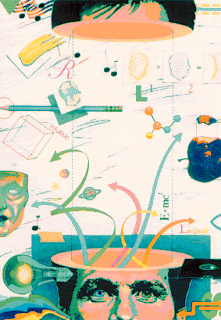
Neurodidactics is a science based on brain research, pedagogic and the function of the brain in the process of learning. It is possible nowadays, using a special tomography to see the “location” of our speech centers on our brain. Studies have proven that bilingual people have one speech center for both languages and for every additional language they learn, they use this particular center. This makes learning for them easier than the rest of us. People who acquire the second language at an earlier age however, develop different speech centers for each language.
Children though have an advantage in learning at an early age. They are more “plastic” in phonology and they learn by imitating. Therefore, they should learn more “actively”, using games and movement.
Let’s go back to the brain.
Neurons are cells in the nervous system and they communicate with each other via synapses. All knowledge we are exposed to goes through these cells. Men have more neurons than women, but this only proves that women can process more complicated tasks by using less neurons. This is the hippocampus. It is our “learn turbo” and the “news detector” in our brain. It is a kind of a switch in our memory, it increases speed in our learning and inspects the new information. It “saves” only what is worth.
Pupils should be presented with new information playfully. Children should be encouraged to associate things, make speculations and think.
Amygdala is a part of our brain which provides perceptions with emotions. It is activated when we get angry or frustrated. Adrenaline is being released and this blocks our process of thinking and learning. When we learn under stress, we can lose up to 60% of our ability to “solve problems”
- Pupils should be encouraged to make positive social contacts (group and pair activities) - They should solve problems creatively. (theater, arts and crafts) - They should be made curious (quizzes etc) - They should communicate with the world (internet, e-mails)
We keep things in mind by: Listening 20% Watching 30% Being active 90% Reading 10% Speaking 70%
Children should be given good examples so they can work out the rules on their own. Sleeping plays an important role in learning. Whatever knowledge is acquired during the day, it is consolidated during sleep.
Brain hemispheres
Left: Speech, logic, order
Right: Interpretation of speech, emotional aspects
The limbic system is the center of emotion, motivation and emotional association with memory. It seems that the brain releases a neurotransmitter substance called dopamine which gives us the feeling of pleasure and enjoyment when completing successfully certain activities. As a result, when a student completes a task successfully, the dopamine makes them feel good. Consequently this stays in his “long memory shelf” with a sense of achievement. Learning is also possible through negative experiences though (memory of failing)
Using various activities in lessons (drama reading, games, music, tongue twisters etc) can be a positive experience for children. Tell me and… I will forget Show me and… I will remember Let me do it and… I will keep it in mind forever Confucius
Sprachen lernen als Prozess in der Primar- und Sekundarstufe
Ein bunter, abwechslungsreicher Strauss an Vorträgen und Präsentationen erwartet sie zum diesjährigen Novemberseminar. Ausgehend von der Frage: Was passiert eigentlich beim Lernen im Gehirn und speziell beim Sprachenlernen? – Weiter zu: Schwierigkeiten und Hilfen bei der Wahrnehmung. – Schließlich: Lernen als Kontinuum und last not least: Highlights.
10.00 – 10.15 Uhr Begrüßung durch Herrn Thalmann (Goethe-Institut Thessaloniki und Frau Prof. Dr. Kiliari Aristoteles-Universität Thessaloniki
10.15 – 11.15 Uhr Gehirn und Lernen Frau Xanthos, Goethe-Institut Athen
11.15 – 11.45 Uhr Der Lernserver Frau Loos, Universität Münster
11.45 – 12.00 Uhr Pause
12.00 – 12.45 Uhr Multisensorische Wahrnehmung: Frau Baumgartner, Goethe-Institut Thessaloniki
12.45 – 13.30 Uhr Dyslexie Frau Barou, Dyslexie-Verband, Thessaloniki, in griechischer Sprache
13.30 – 14.15 Uhr Test- und Therapieverfahren Frau Gohlke, Blicklabor Thessaloniki
14.15 – 14.45 Uhr LingoTech Karin Vavatzanidis, Goethe-Institut Thessaloniki
14.45 – 15.00 Uhr Pause
15.00 – 15.45 Uhr Sprachen lernen als Kontinuum Frau Dr. Papadopoulou, Aritstoteles-Universität Thessaloniki
15.45 – 16.15 Uhr Comics am PC erstellen Frau Kerkinopoulou und Frau Tokmakidou, beide staatliche Schulen, Thessaloniki
This is the schedule of the day. Unfortunately I couldn't stay till the end. I will try and present some of the knowledge I acquired by this seminar in my nextx posts. Some aspects are really interesting for everybody and not just teachers.


.JPG)




 Studies have proven that bilingual people have one speech center for both languages and for every additional language they learn, they use this particular center. This makes learning for them easier than the rest of us.

 This is the hippocampus. It is our “learn turbo” and the “news detector” in our brain. It is a kind of a switch in our memory, it increases speed in our learning and inspects the new information. It “saves” only what is worth.


